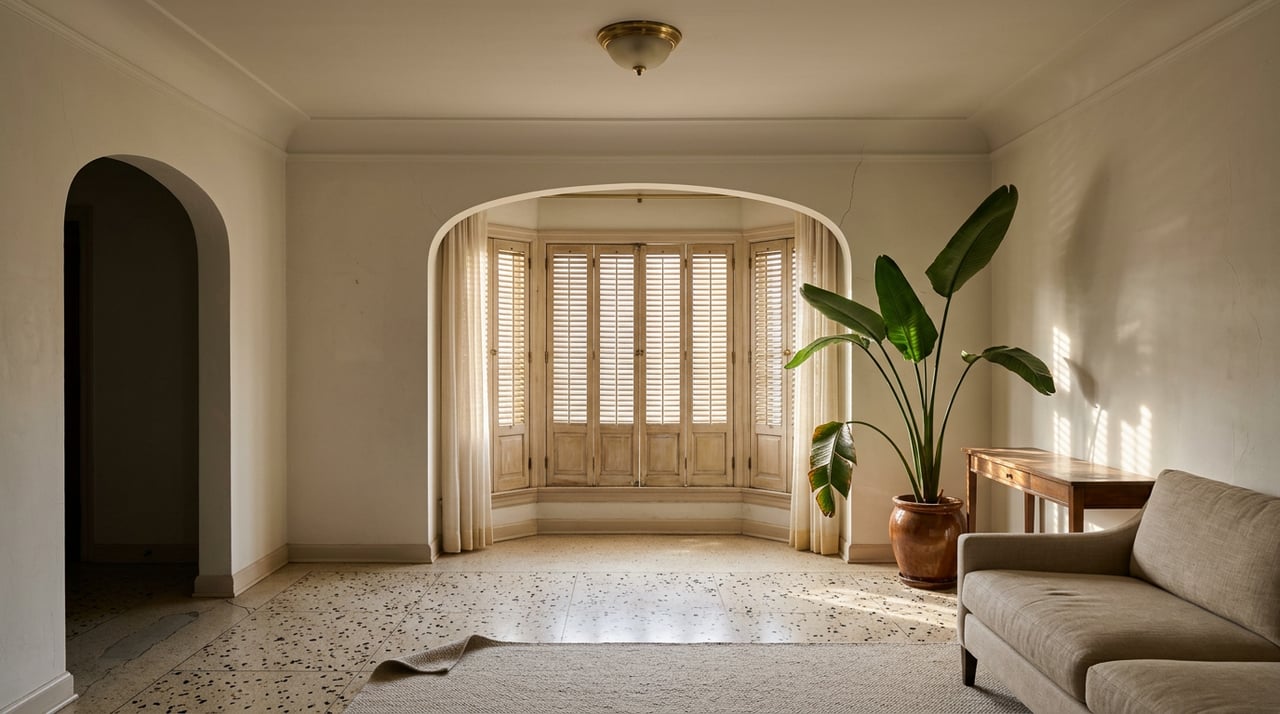
In Miramar, the Historic Zone Ends Mid-Block, Not at the Neighborhood Line
August 13, 2026
August 13, 2026
Two houses can sit across the street from each other in Miramar, both built in the same decade of prosperity, both wearing the same Spanish Revival details, and only one of them is legally historic. The other missed the cutoff by a boundary line that was redrawn once already and an age rule that has nothing to do with how old a house looks.
That distinction is not trivia. It decides whether you need a certificate from the Instituto de Cultura Puertorriqueña before you touch a facade, whether your rental income is taxed at all, and whether the renovation you're planning is a straightforward permit or a multi-agency review. Buyers who treat "Miramar" as a single historic label find this out at the worst possible moment, usually after an offer is accepted.
Miramar's historic zone was created by law in 2005, and the perimeter described in that original text ran along the Expreso Baldorioty de Castro and the Condado Lagoon to the north, Calle Cerra to the east, and the Expreso Luis Muñoz Rivera on both the south and west sides. The law declared as a historic zone the urban area of San Juan historically known as Miramar and surrounding sectors within that perimeter.
Five years later, the boundary grew. A 2010 amendment expanded the historic zone to include the area bounded by Marginal, Central, and Villaverde streets and Baldorioty Boulevard to the south, as well as Baldorioty Boulevard to the west. A property that sat just outside the protected zone in 2005 could be inside it today, and a map printed before that amendment is no longer reliable.
There's a third layer worth knowing about. Separate from the 2005 law, the neighborhood was also listed on the Puerto Rico Register of Historic Sites and Zones in 2007 for its historical and architectural value. Two different designations, two different years, one neighborhood. Before you write an offer that assumes any particular treatment of a property, the current map from the Planning Board is the only document that settles the question.
Inside that boundary, age still matters. Structures built after the start of the second half of the last century are excluded from the designation, except those expressly included by the Planning Board in consultation with the Institute of Puerto Rican Culture and the property owners. In plain terms, a mid-century or newer building sitting on a historic street does not automatically inherit the protections, or the paperwork, of its older neighbors.
It cuts the other way too. The Planning Board retains authority to remove older buildings from the designation on a case-by-case basis after the same consultation process, which means neither an old build date nor a location inside the mapped perimeter guarantees an outcome. Age is where the analysis starts, not where it ends.
The reason any of this is worth protecting traces back to who built the neighborhood in the first place. Pedro de Castro designed close to forty structures in the area, working alongside Nechodoma, Carnicroega, O'Kelly, Ramírez de Arellano, Martínez Lázaro, Porrata Doria, Ferrero, Carrión, Pérez Pierret, Pons, Esteves, Fernández García, Sevillano, and Fortuño. A handful of their buildings still stand and give the streetscape its character today, including the former residence of ex-Chief Justice Emilio del Toro Cuebas, a Spanish Revival multi-story building designed by O'Kelly, a neo-Gothic chapel by Antonio Nechodoma on Avenida Miramar, the homes on Calle Trigo, the former mansion of José Benítez on Avenida Ponce de León, Casa Aboy which now operates as a cultural center, and Villa Giralda on Avenida Miramar.
Any exterior or structural change to a building like these does not go straight to a municipal permit desk. Christie's International Real Estate has noted plainly that historic district properties require review by the preservation committee before other approvals proceed, a step that adds time to any renovation timeline regardless of how minor the visible change looks from the street.
The general Puerto Rico permitting framework already routes certain properties through extra review. Properties within FEMA flood hazard areas, coastal zone management areas, historic districts, or environmental resource areas require additional agency concurrences before the central permits office, OGPe, issues a permit. For a historic Miramar parcel, that additional concurrence is the ICP sign-off, and it needs to happen before a contractor breaks ground, not after plans are already drawn and priced.
The buyers who run into trouble are usually the ones who assumed a listing described as "in Miramar's historic district" meant the ICP step was a formality. It isn't. It's a separate review with its own timeline, and it belongs in your due diligence period, not your post-closing to-do list.
None of this is purely a cost. The same designation that slows down a renovation also unlocks two tax benefits that don't exist for a comparable house outside the zone. Income received from renting existing buildings in Puerto Rico's historic zones or designated historic sites is exempt from income tax, once those buildings have been improved or restored. A parallel exemption applies to property tax on the same qualifying structures.
The modern administration of that exemption runs through two agencies working in sequence. The application for a historic property or home tax exemption is filed with an ICP document from its Historic Built Heritage Program, and under Act 60 of 2019, Puerto Rico's Incentives Code, the Department of Economic Development and Commerce issues the underlying decision while CRIM processes the exemption itself. Miramar is named specifically among the qualifying zones, alongside Old San Juan, Sagrado Corazón, and several municipalities outside the metro area. The exemption is real money, but it is earned through the ICP process, not granted simply for owning an old address.
Not every parcel with a Miramar mailing address falls under any of this. When the Planning Board's sectoral study reviewed the zone's current boundary, it proposed excluding several lots west of the Muñoz Rivera Expressway, land that sits largely vacant and forms part of the Convention Center District rather than the residential historic core.
That excluded land is where a very different Miramar story has been playing out this year. Centuria Opportunities Fund received approval for an incentives decree in March 2022, and it has been publicly identified as the developer behind Opus Miramar, a 40-unit luxury residential project rising on Convention Center District land acquired for $6 million, with the total investment estimated at $80 million. In June 2026, Puerto Rico's Senate sent the Department of Economic Development and Commerce a formal information request asking whether Opus Miramar or any affiliated entity holds an active or pending tax exemption decree under Act 60, along with copies of communications between the developer and the agency dating back to 2023.
That project sits nowhere near an ICP review or a Sección 4.3 rental exemption. It runs on a completely separate incentive track built for private capital and new construction, not restoration. Two developments a short walk apart in the same neighborhood, governed by two unrelated sets of rules, is exactly the kind of detail that a boundary map settles and a listing description never will.
The restriction and the appeal come from the same source. Miramar's lagoon-front lots and historic streetscapes have essentially no remaining developable parcels at the water's edge, which is a large part of why demand keeps concentrating on the existing housing stock rather than spreading to new towers along the shoreline. The same law that requires ICP review before you can add a second story is the reason there won't be a wave of new construction diluting the character, or the scarcity, that made you interested in the first place.
| Inside the historic zone, built before roughly 1950 | Outside the mapped zone, or built after roughly 1950 | |
|---|---|---|
| Exterior or structural renovation | Requires ICP certificate before OGPe permit review | Standard municipal and OGPe review only |
| Property tax exemption | Available once ICP certifies restoration | Not available |
| Rental income tax exemption | Available on income from a restored building, under Act 60 | Not available |
| Teardown or full rebuild | Requires Planning Board review in consultation with ICP | Governed by standard zoning |
How do I find out if my specific address is inside the mapped historic zone? The boundary changed between 2005 and 2010, so the only reliable source is the current map maintained by the Puerto Rico Planning Board, not a listing description or a general sense of which streets "feel" historic.
Does the tax exemption apply the moment I buy a historic home? No. The exemption on rental income and property tax applies once the building has been improved or restored and the Institute of Puerto Rican Culture has certified that work, with the Department of Economic Development and Commerce issuing the decree and CRIM administering it.
Can a building constructed after 1950 inside the boundary ever qualify? Yes, but only if the Planning Board expressly includes it after consulting with the Institute of Puerto Rican Culture and the property owner. It is the exception, not the default.
If you're weighing a purchase in Miramar, whether it's a Spanish Revival property that needs the ICP process worked into your timeline or new construction near the Convention Center District that answers to a different set of rules, Lynnette Cartagena can help you confirm which Miramar you're actually buying into before you write the offer. Let's Connect.
Stay up to date on the latest real estate trends.


Partner with a trusted real estate professional who combines deep local knowledge, personalized guidance, and a commitment to helping you achieve your goals.