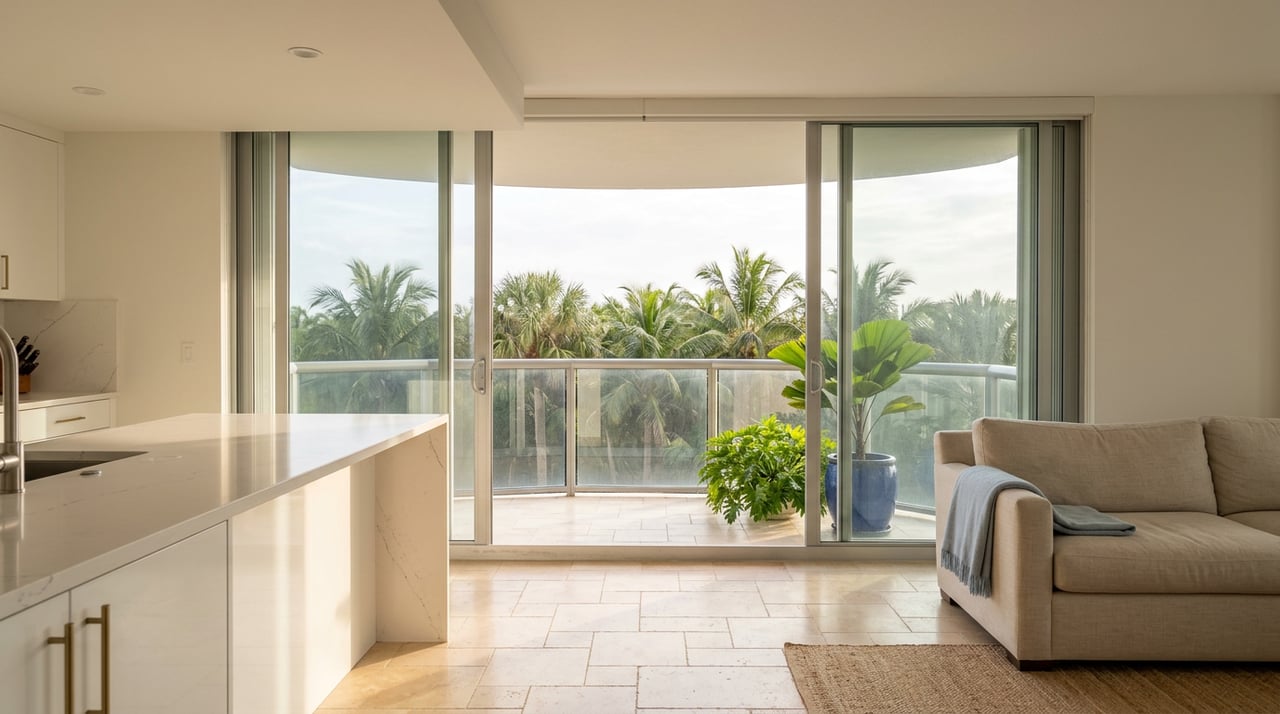
What Condado Condo HOA Fees and Insurance Costs Reveal
August 13, 2026
August 13, 2026
Two condos in Condado can list at nearly the same price, with the same square footage and a similar slice of ocean view, and still cost their owners very different amounts every month in ways the listing photos never show. One buyer finds this out while reading HOA documents before closing. The other finds out after the first serious hurricane season, when a special assessment notice arrives with a due date already attached.
The gap between those two experiences comes down to a short list of numbers most buyers never ask about until they are already under contract: the monthly association fee, the way the building's insurance is structured, and whether the reserve fund has actually kept pace with the tower's age. In Condado, where oceanfront buildings from different decades sit blocks apart along the same run of coastline, those numbers can diverge sharply between towers that look, on paper, almost identical.
Take a three-bedroom, 2,080-square-foot ocean-view unit in El Rey Condominium, steps from the beach in the heart of Condado. Its monthly HOA runs about $517, with insurance costing the owner roughly $2,800 a year. Now compare that to the range typical of Puerto Rico's fuller-amenity luxury developments, where monthly HOA fees run $800 to $3,500 depending on concierge staffing, security level, and shared infrastructure, with Condado high-rises in particular often bundling concierge services, pool maintenance, and building insurance into that single number. At the very top of the local market, a $3.5 million Condado penthouse carries an entirely different cost structure than either of those examples, one built around full-time staffing and a much larger insured replacement value.
Three buildings, three fee structures, all sitting inside the same walkable stretch of Condado. Here is roughly how that spread breaks down by building type:
| Building type | Typical monthly HOA | What tends to be bundled in |
|---|---|---|
| Modest ocean-adjacent tower (like El Rey) | Around $500 | Building insurance component, basic common-area upkeep |
| Full-amenity Condado high-rise | $800 to $3,500 | Concierge, doormen, pool and gym maintenance, higher master insurance |
| Top-tier penthouse-level building | Well above that range | Full staffing, elevated replacement-cost insurance, extensive shared infrastructure |
None of this shows up in a price-per-square-foot comparison. It shows up in the association's budget, which is exactly why the budget deserves as much attention as the unit itself.
The monthly fee is really a proxy for something larger: how a building has chosen to insure itself against wind, flood, and the ordinary wear of salt air. Condado's coastal setting means some buildings sit inside FEMA flood zones or carry real storm-surge exposure, while others just a few blocks inland do not. Wind deductibles in these policies are frequently set as a percentage of the building's insured value rather than a flat dollar figure, which means that after a major storm, the association's out-of-pocket exposure can be far larger than a buyer would guess from the monthly due alone.
Backup generators and water systems complicate the picture further. Buildings that maintain them are more resilient during island-wide power or water interruptions, but that resilience shows up as higher fuel and maintenance costs baked into the HOA line item. A healthy association also sets aside reserves for the big, unavoidable projects that come with owning a concrete tower on the water: roof work, façade repair, elevator upgrades, pool replastering. Underfunded reserves are one of the more common reasons buildings end up levying a special assessment when one of those projects can no longer be deferred.
None of this means a higher fee is automatically a red flag or a lower one is automatically a bargain. It means the fee is a summary of decisions the building made years before you arrived, and summaries deserve a second look before you sign anything.
Every one of these numbers exists in writing somewhere in the building's files, and a buyer working with a broker who knows the local buildings can request them before an offer goes in, not after. Three documents in particular are worth asking for:
A monthly fee is not a fixed cost. It's a snapshot of how well a building has planned for its own future, and that snapshot is worth reading before you write an offer, not after you own the answer.
Condado consistently draws consistent metro and beach tourism, which is part of why it shows up on lists of the island's stronger short-term rental corridors. But the neighborhood's tourism demand is only half the equation for anyone weighing a purchase with rental income in mind. As of mid-2026, operating a short-term rental in Puerto Rico means registering as an innkeeper, or hostelero, with the Puerto Rico Tourism Company, collecting the 7 percent room occupancy tax from guests, according to InvestatePR. Legislation has also been under consideration to create a centralized, island-wide registry and licensing framework, so the regulatory picture is one to confirm at the time of purchase rather than assume from an older guide.
The friction that catches buyers off guard, though, usually has nothing to do with any of that. It's the building itself. Individual condo declarations in Condado can prohibit short-term rentals outright, regardless of how strong the neighborhood's tourism numbers look or how permissive the municipality is. A unit can sit inside one of the metro area's most reliable rental markets and still be legally off-limits to Airbnb-style stays because of a single clause in the association's governing documents. That clause matters more to your return than any occupancy statistic you'll find for the neighborhood as a whole.
Having represented buyers and sellers along this stretch of coast for years, the pattern I see most often is a buyer who has done real homework on the neighborhood and none on the specific tower. Condado rewards that second layer of homework more than most places, because the difference between two nearly identical listings usually lives in the association's paperwork, not in anything a photographer could have captured.
The sale price gets you in the door. The HOA certification, the reserve study, and the building's own claims history tell you what happens after that door closes behind you.
Does a lower HOA fee always mean a better deal? Not on its own. A modest fee can simply reflect a smaller building with lighter amenities, or it can reflect reserves that haven't kept pace with the tower's age. The fee only becomes meaningful once you've seen the reserve study and the assessment history behind it.
Can every Condado building operate as a short-term rental? No. Even in a neighborhood known for consistent tourism demand, individual condo declarations can prohibit short-term rentals entirely. Confirm the building's specific bylaws before assuming the neighborhood's rental reputation applies to your unit.
What's the first document I should ask for on a Condado condo? Start with the Certificación de Cuotas. It shows current fees, any pending special assessments, and the community rules you'd be agreeing to as an owner, and it's the fastest way to see whether a building's finances match its reputation.
If you're comparing Condado buildings and want a second set of eyes on what a fee actually reflects, Your Condado Realtor has spent nearly two decades reading these buildings from the inside. Let's Connect.
This article is general information, not legal, tax or financial advice. Consult a qualified professional about your situation.
Stay up to date on the latest real estate trends.


Partner with a trusted real estate professional who combines deep local knowledge, personalized guidance, and a commitment to helping you achieve your goals.