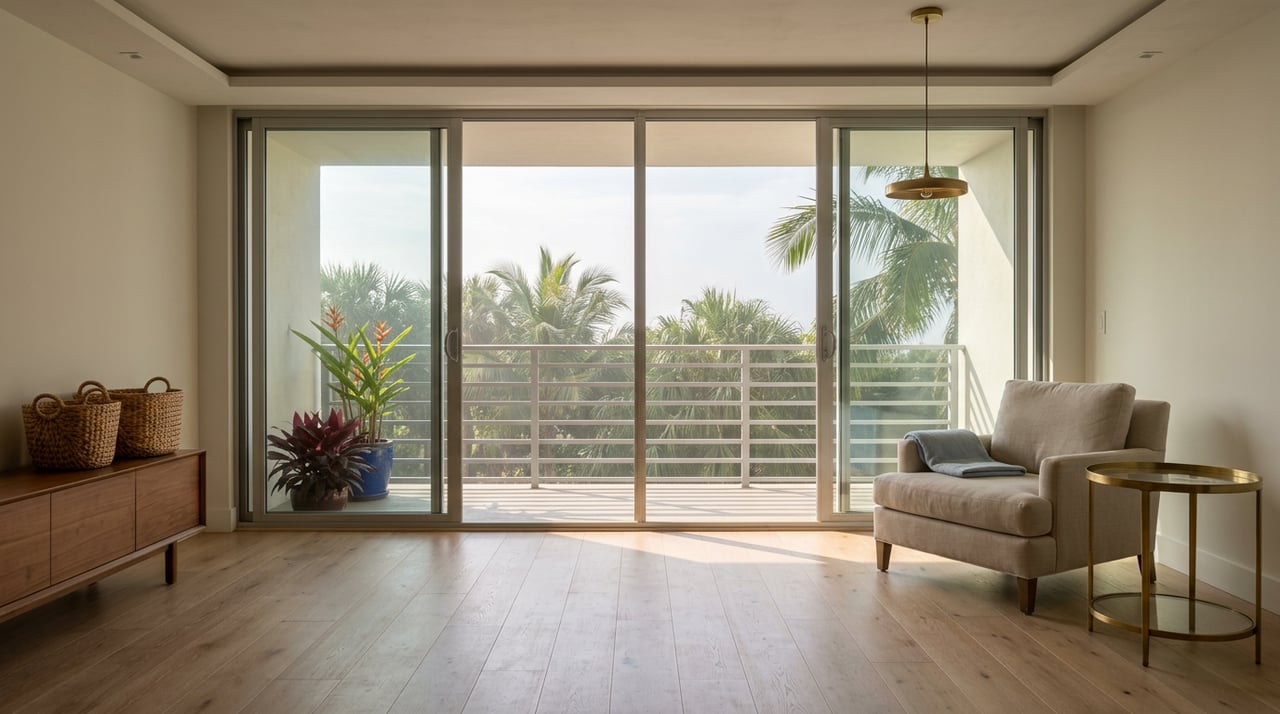
In Isla Verde, Your Airbnb Rights Live in a Document You Used to Never See
August 13, 2026
August 13, 2026
During oral arguments in 2018, Associate Justice Anabelle Rodríguez pressed the lawyers on a plain question: if a guest checks into a condo for five days, is that person a resident or just visiting. Working through her own reasoning out loud, she warned that letting guests rotate through on quick stays would turn the building into something that looked, in her words, like "lobby del Caribe Hilton."
The case being argued was not about a hotel. It was about one apartment at Condominio Condesa del Mar in the tourist zone of Isla Verde in Carolina, where owner Eduardo Chamah had started listing his unit on Airbnb and HomeAway, and the condo's board argued he was violating rules that barred commercial use of the apartments in a building whose master deed calls for exclusively residential use. The dispute climbed from a lower court, where an appellate panel ruled that owners have the right to rent for whatever term they consider convenient unless it is expressly prohibited in the deed, all the way to the island's highest court, which issued its decision in 2019 under the citation 202 DPR 173, with Justice Rodríguez writing a dissent.
That fight happened in Isla Verde because Isla Verde is where this question was always going to surface first. It is a corridor built almost entirely out of the same kind of building at the center of the Condesa del Mar case: concrete towers steps from the sand, sold as much to investors chasing nightly rates as to residents. The court case forced a question that every one of those towers eventually had to answer for itself. And for years, the answer sat buried in a document that a buyer, no matter how many nights they planned to list, had almost no legal way to see before they signed.
Two years after the Condesa del Mar arguments, the legislature settled the underlying legal question directly. Puerto Rico's 2020 Condominium Act, Law 129-2020, took up short-term rentals by name. It established that short-term rentals cannot be prohibited unless the master deed or the bylaws set a minimum lease term, and it gave condo boards the authority to regulate how those rentals are conducted. So far, that reads like a win for anyone buying with rental income in mind.
The next sentence of the law is the one that matters more. Councils of owners have the power, at any time, to amend the master deed or the bylaws to establish, modify, or eliminate the prohibition on short-term rentals that the law allows them to adopt. In other words, the rule that governs your ability to rent nightly is not fixed at the moment you buy. It is a live setting that a board can flip at a future assembly, and the only place that setting is written down is a document most buyers never asked to see until they were already sitting at the notary's table, deed in hand.
That gap is what Law No. 13-2026 was written to close. Governor Jenniffer González signed the measure, authored by Representative José J. Pérez, in January 2026, amending Article 13 of the 2020 Condominium Act. The new rule is specific: a condo's administrator must notify and deliver a copy of the bylaws to a real estate broker handling the sale of a unit, once that broker's mandate is verified, or to a potential buyer who requests it, within a term no longer than five business days.
The law also spells out who can be asked to prove they belong in the conversation. The administrator can require the requesting broker's license number, photo identification, phone number, mailing address, and email, and is not required to hand the bylaws to any broker or third party who lacks a legitimate interest in a specific transaction. If a building has no administrator, the responsibility for delivering the documents falls to the board president, or the secretary if there is no president.
Here is what that looks like in practice, before and after:
| Before Law No. 13-2026 | After Law No. 13-2026 | |
|---|---|---|
| Getting the bylaws before closing | No statutory deadline; many buyers didn't see them until the deed was drafted | Administrator must deliver a copy within 5 business days of a verified request |
| Who can ask | Left entirely to the building's discretion | A broker with an accredited sale mandate, or a buyer who requests it directly |
| If there's no administrator | Unclear who was responsible | Falls to the board president, or the secretary if there's no president |
| Access to short-term rental rules | Effectively locked in until after signing | Available while there's still room to negotiate or walk away |
For a buyer weighing an Isla Verde unit specifically for its rental income, that shift moves the moment of truth from after closing to before an offer is even written.
The timing matters for another reason. The building-by-building rules are only half the underwriting question. The other half is whether the income assumptions behind an Isla Verde short-term rental purchase still hold up.
Puerto Rico's short-term rental sector grew quickly after the pandemic, when hosts who might have rented long-term instead moved their units onto nightly platforms, and analysts now describe that market as saturated enough that income has fallen, pushing many owners back toward traditional long-term leases. René Acosta, co-founder of the Viva Puerto Rico Short Term Rental Alliance, told reporters that operators he talks with describe a harder business with lower demand, as more competitors entered the sector. By his informal count, the island now holds roughly 25,000 active short-term rental units, down from earlier estimates near 30,000. Irma Colón, president of the island's Realtors association, put it more bluntly, saying she is seeing owners who bought properties specifically to convert into short-term rentals now calling to ask about long-term tenants instead. That reporting is from October 2025, so treat it as a snapshot of a trend rather than this month's figure, but the direction is the relevant part: a building's willingness to allow nightly rentals is worth less if the market for those rentals has cooled since the projection you were shown.
This is the whole reason the bylaws matter more than the sales pitch. A listing agent can describe a building as investor-friendly. Only the reglamento tells you whether that friendliness is written into the master deed or just tolerated until the next assembly vote, and only the new five-day window lets you find out before you're committed.
If you're looking at a unit in Isla Verde with rental income in mind, ask for these documents directly, and put the request in writing so the five-day clock has a clear start date:
Does this disclosure law apply only in Isla Verde, or across Puerto Rico? It applies island-wide. When the underlying bill was first filed in 2024, lawmakers cited an estimated 3,500 horizontal-property complexes on the island, home to more than half a million residents, all of which fall under the same disclosure requirement today.
If a building currently allows short-term rentals, can that change after I buy? Yes. Councils of owners can amend the master deed or bylaws at any time to add, modify, or remove a short-term rental restriction. Buying into a permissive building today is not a guarantee the rule stays that way.
Who is legally on the hook to hand over the bylaws? The condo's administrator, or if the building doesn't have one, the board president, or the secretary if there is no president.
Can just anyone request the documents? No. The administrator can require proof of license and identity from a broker, and is not obligated to release the bylaws to someone without a legitimate interest in a specific transaction.
Isla Verde has always rewarded buyers who did their homework on the building, not just the beach. What changed this year is how early that homework can start. If you're weighing a condo here for rental income, primary residence, or something in between, Lynnette Cartagena can help you request the right documents at the right moment, before you're competing for a unit instead of understanding it. Let's Connect.
Stay up to date on the latest real estate trends.





Partner with a trusted real estate professional who combines deep local knowledge, personalized guidance, and a commitment to helping you achieve your goals.